

Are you worried that your child isn't hitting their developmental milestones? Do they struggle with emotional regulation and school? Have a hard time focusing or making friends? Does your Mama intuition feel like something deeper is holding them back, even when you can't quite name it? You are not alone!
What are Primitive reflexes?
Primitive Reflexes are foundational neurological responses that evolve in utero and are essential for a child's developmental milestones. It is how the brain is designed to develop. Most primitive reflexes should integrate by the age of 3, but in some children, this does not happen. When reflexes remain unintegrated, it places chronic stress on the nervous system of the developing child, impairing motor skills, emotional regulation, and cognitive development. Unintegrated Reflexes force the brain to work harder to compensate for undeveloped connections. Luckily, we can work on these reflex patterns, even after the age of 3, to help the child develop and to improve motor function, emotional regulation, and cognitive skills. In fact, reflex integration is also beneficial for adults, especially those with trauma, concussions, and neurodegenerative diseases like MS, Parkinsons and ALS.
A common reflex pattern is the Moro or startle reflex. When a mother changes the head position of a baby in her arms, the child arches the head back, opens the core of the body, extends the arms and fingers, while taking a deep breath in and holding it. This is a very important reflex for the baby's first breath, and it should be integrated within 3-4 months of life. A few symptoms of what we can see, if this reflex remains unintegrated, are:
generalized insecurity, anxiety, and fearfulness.
aggressive outbursts
immature eye movements (difficulty with learning how to read)
allergies and chronic illness due to stress hormones being released from a lack of integration
vestibular challenges, motion sickness
sensitivity to light, sounds, and textures
headaches
cravings for sweets and more
The body is stuck in a state of overall fight or flight until this reflex gets integrated!



How are reflexes integrated?
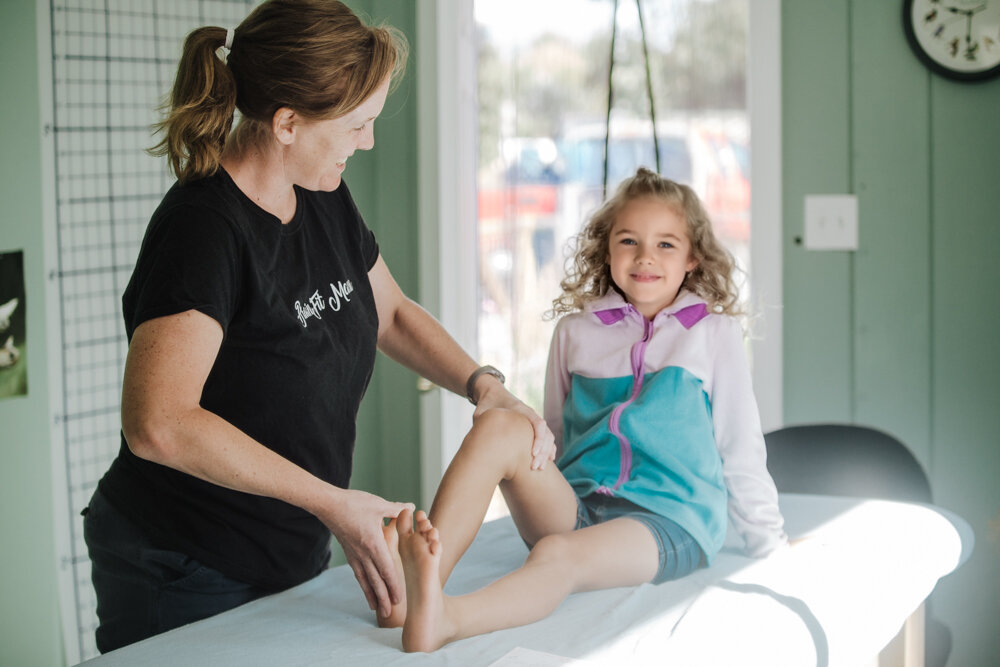
At BFM, we use the Quantum Reflex Integration method developed by Bonnie Brandes. This method uses low level laser therapy and sound, to repair nerve cells and stimulate reflex integration. Home exercises are given to help with the integration process. BFM gives a reasonable number of exercises, averaging 15-20 minutes a day, to help speed the process along. Making new connections and pathways in the brain takes time and repetition. Think of wanting to make a path in a meadow. If you walk the same line, every week, the vegetation will eventually stop growing due to the walking, and a path will soon form. If you walk it daily, (ie home exercises) it will form much sooner and the path will be clearer. That is why the home exercises are so valuable to the child's improvement. Those new neural pathways that are formed by Reflex Integration and home exercises improves overall function.
Who benefits from reflex integration?
Those with, but not limited to:
Autism
Learning Delays
Speech Delays
Anxiety
OCD
Emotional Dysregulation
Attention Deficits
Sensory Processing Issues
Trauma
And more
Check out the PRIMARY REFLEX MOVEMENT PATTERNS CHECKLIST to get a better idea of how reflexes affect our development. Under each reflex is a list of symptoms that you may experience if the reflex is not fully integrated. The good news is that even if you have an issue with multiple reflexes, they can be reintegrated with some time and effort.
Other modalities used at BFM to help reflexes integrate:
Nutrition Response Testing helps introduce deep nutrition and supports detoxification, allowing the brain to function optimally.
QNRT to help balance the brain lobes, to synergistically help the reflex integration.
Hyperbaric Oxygen Therapy to oxygenate the brain
The Listening Program, an at-home therapy that takes 15-30 minutes a day, helps improve brain function and calm the nervous system. The whole family can use the Listening Program to help their Nervous system.
RECOMMENDED READING:
The Symphony of Reflexes by Bonnie Brandes
Disconnected Kids by Dr. Robert Melillo
Smart Moves by Carla Hannaford
The Well-Balanced Child by Sally Goddard Blythe
Outsmarting Autism by Patricia S. Lemer
The Rhythmic Movement Method by Dr. Harold Blomberg
Pressing Reset: Original Strength by Tim Anderson
“Before working with Addy, our now 7-year-old child with autism was constantly overreacting to certain stimuli and was completely tuned out to others. She is now more regulated, less impulsive and more in control of her responses. Her language and social growth has improved dramatically. It is as if her body and brain are being lifted out of a long lasting fog. Thank you, Addy, for seeing her as she is and delighting in her. Your heart to help is such a blessing!”